October 22, 2026
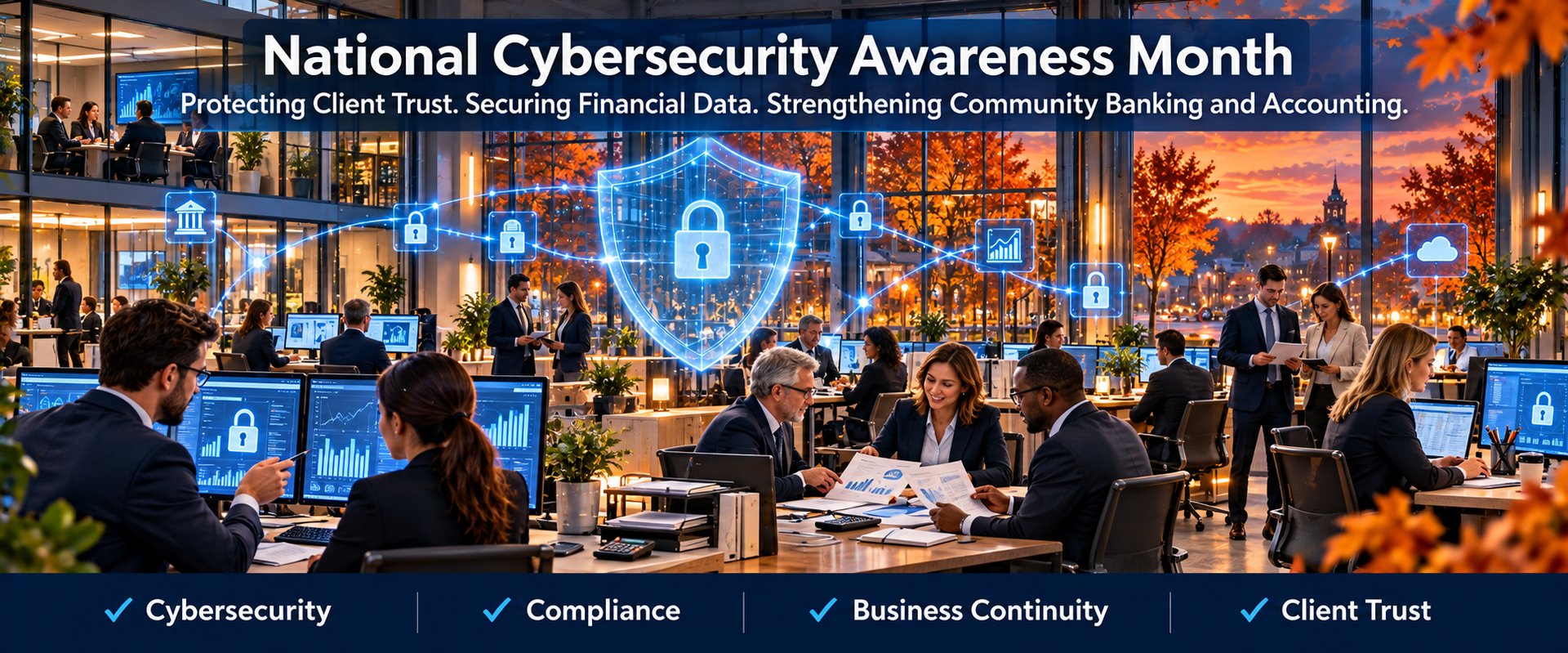
October brings falling leaves, Halloween decorations, and National Cybersecurity Awareness Month.
While Halloween is known for disguises and deception, community banks and CPA firms face real-world threats that rely on many of the same tactics. Criminals impersonate trusted contacts, disguise fraudulent requests as legitimate business communications, and look for opportunities to access sensitive financial information.
The challenge is that today's cyber threats rarely look threatening.
They often arrive disguised as a client email, a wire transfer request, a tax document, or a message from a trusted vendor.
For financial institutions and accounting firms, cybersecurity isn't just about technology. It's about protecting client trust, safeguarding sensitive data, maintaining compliance, and ensuring business continuity.
The Scariest Threats Don't Look Suspicious
Years ago, fraudulent emails often contained obvious red flags. Poor grammar, unusual formatting, and suspicious sender information made them easier to spot.
Today's cybercriminals have become much more sophisticated.
Artificial Intelligence allows attackers to create professional-looking emails, generate convincing messages, and even mimic communication styles used by trusted contacts.
An email appearing to come from a customer.
A request to update banking information.
A message asking for tax records.
A vendor requesting payment changes.
All may appear legitimate at first glance.
For community banks and CPA firms, these attacks are particularly dangerous because they target the trust that drives client relationships.
Why Financial Organizations Remain Prime Targets
Community banks and accounting firms manage some of the most valuable information an organization can possess:
- Personally Identifiable Information (PII)
- Financial records
- Tax documentation
- Banking information
- Payroll data
- Loan information
- Business financial statements
- Customer and client records
Cybercriminals understand the value of this data.
They also understand that financial organizations operate in a highly regulated environment where downtime, data loss, and compliance failures can have significant consequences.
That's why cybersecurity has become a business imperative rather than simply an IT function.
Three Cyber "Monsters" Financial Organizations Should Watch For
The Phantom Client
Everything about the email appears normal.
The name is familiar. The writing style feels authentic. The request seems routine.
Perhaps a client needs updated account information. Perhaps they need a tax document resent. Maybe they want to change banking instructions.
The danger isn't the request itself.
The danger is acting on the request without verification.
Strong verification procedures remain one of the most effective defenses against fraud and social engineering attacks.
Trust matters.
Verification matters more.
The Disappearing Records Monster
Imagine arriving at work and finding critical files unavailable.
Client information cannot be accessed. Financial records are locked. Staff cannot perform routine business functions.
Cybercriminals increasingly target organizations with ransomware because they know access to information is critical to daily operations.
This is why backups, incident response planning, recovery testing, and business continuity strategies are so important.
A backup strategy isn't about storing data.
It's about maintaining the ability to serve customers and clients when problems occur.
The AI Shapeshifter
Artificial Intelligence is creating tremendous opportunities for banks and accounting firms.
From workflow automation to client service improvements, AI can deliver meaningful efficiencies.
However, unapproved AI usage can introduce new risks.
Employees may unknowingly enter:
- Client financial information
- Tax documentation
- Banking records
- Internal reports
- Confidential business information
into public AI tools that have not been vetted by the organization.
That's why every financial organization should have clear AI governance policies that answer questions such as:
- Which AI tools are approved?
- What information may be entered into AI systems?
- How should AI-generated content be validated?
- Who approves new AI technologies?
The goal isn't to avoid innovation.
The goal is to embrace innovation responsibly.
Cybersecurity Is a Trust-Building Strategy
Community banks and CPA firms succeed because clients trust them with their most sensitive information.
Cybersecurity is one of the most important ways organizations demonstrate that trust is well-placed.
When customers and clients know their information is being protected through strong safeguards, documented processes, employee training, and responsible technology practices, confidence grows.
The strongest financial organizations understand that cybersecurity supports:
- Client trust
- Regulatory compliance
- Operational resilience
- Business continuity
- Reputation management
- Long-term growth
These outcomes matter just as much as the technology itself.
Small Improvements Make a Big Difference
The good news is that strengthening cybersecurity doesn't require dramatic changes overnight.
Many of the most effective safeguards are also the most practical:
- Multi-factor authentication
- Employee security awareness training
- Vendor risk reviews
- Password management
- Access control reviews
- Backup testing
- Incident response planning
- AI governance policies
- Regular cybersecurity assessments
These foundational controls can significantly reduce risk while helping organizations meet regulatory and client expectations.
A Season for Confidence, Not Fear
National Cybersecurity Awareness Month should not be viewed as a reminder of everything that can go wrong.
Instead, it should be viewed as an opportunity.
An opportunity to strengthen policies.
An opportunity to educate employees.
An opportunity to improve processes.
An opportunity to build greater resilience.
The reality is that most successful organizations are not the ones that eliminate every risk. They are the ones that continuously improve, adapt, and prepare for change.
For community banks and CPA firms, that's good news.
Each security improvement, employee conversation, policy review, and technology investment helps create a stronger organization that is better equipped to protect clients and serve its community.
Protect What Matters Most
At DigeTekS, we help community banks and CPA firms strengthen cybersecurity, align with compliance requirements, reduce operational risk, and safely adopt emerging technologies like AI.
Because cybersecurity isn't just about stopping threats.
It's about protecting trust, supporting growth, and helping your organization confidently serve clients for years to come.
Schedule a complimentary 10-minute discovery call with DigeTekS to discuss your cybersecurity strategy, compliance requirements, and technology goals.
📞 833-443-8357
🌐 digeteks.com
This National Cybersecurity Awareness Month, don't focus on the monsters. Focus on building a stronger, more resilient organization that your clients can continue to trust.