October 27, 2026
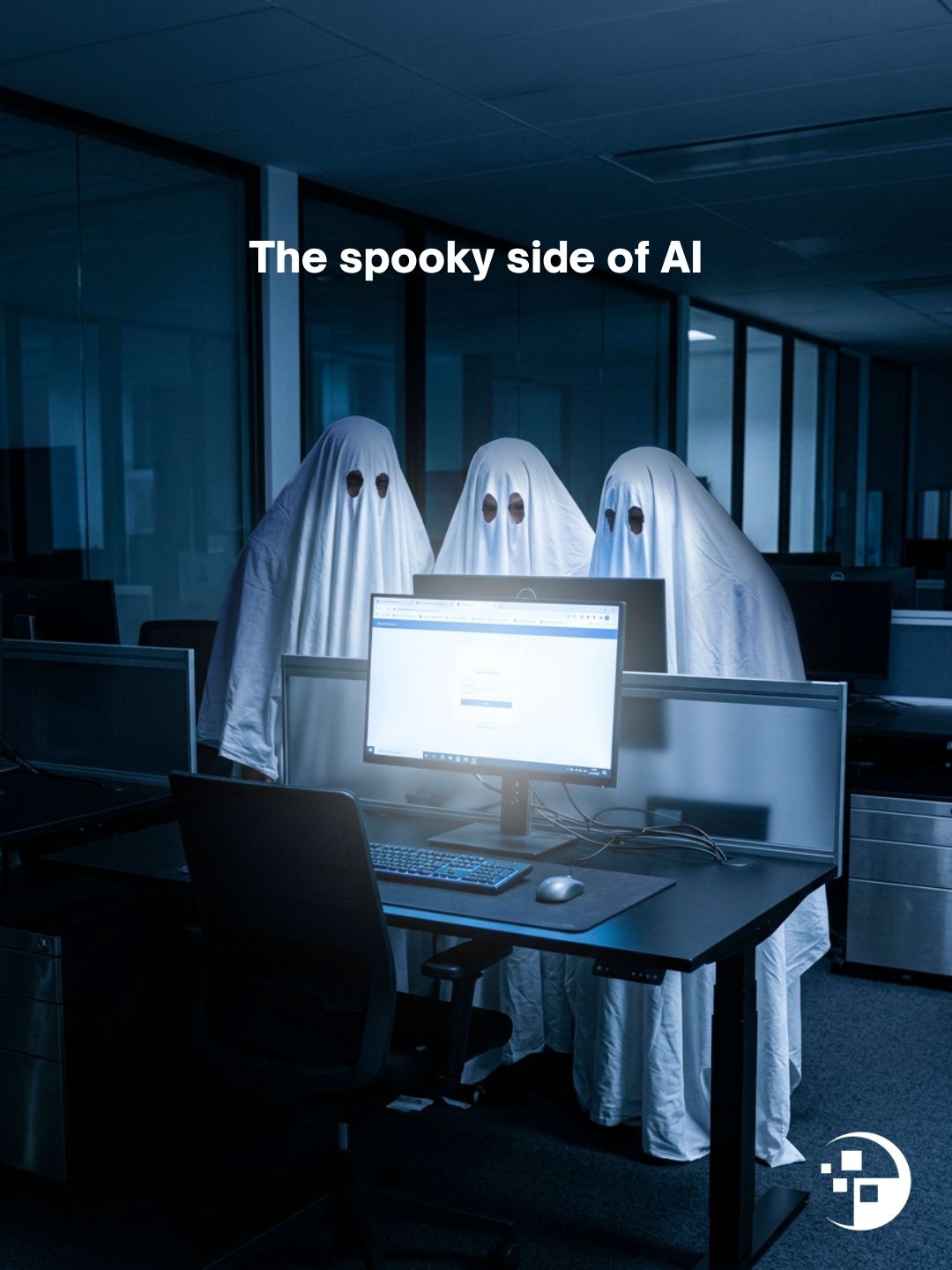
October is full of haunted houses, ghosts, and Halloween surprises. But for today's businesses, the most concerning threats aren't hiding behind masks.
They're hiding behind convincing emails, realistic voice messages, polished documents, and seemingly helpful AI tools.
As Artificial Intelligence becomes more powerful and accessible, it's creating exciting opportunities for businesses to improve productivity, automate routine tasks, and strengthen operations. Unfortunately, cybercriminals are embracing the same technology to make their attacks faster, more targeted, and harder to recognize.
The good news? Protecting your business doesn't require becoming an AI expert. It requires strong policies, clear processes, employee awareness, and a cybersecurity strategy built around risk management and business continuity.
This Halloween, let's look at some of the most common AI-powered threats businesses face and what you can do to stay protected.
AI Shapeshifters: When Seeing and Hearing Isn't Believing
For years, businesses relied on audio and video as trusted forms of communication.
A voicemail from a manager felt authentic. A video message from an executive carried credibility. A phone call from a vendor seemed legitimate.
Today, AI-generated voice cloning and deepfake technology are changing that reality.
Cybercriminals can now create convincing audio and video content designed to impersonate executives, employees, vendors, and business partners. A message may sound exactly like someone you know. A video may appear genuine.
That's what makes these attacks dangerous.
Instead of relying solely on appearances, organizations should focus on verification procedures that cannot be easily manipulated.
For example:
- Verify wire transfer requests through a secondary communication method
- Confirm account changes directly with trusted contacts
- Require approval workflows for financial transactions
- Use multi-factor authentication to validate access requests
- Establish documented procedures for handling sensitive information
Technology can imitate a voice. It cannot bypass a well-designed security process.
AI Mummies: Old Scams Wrapped in New Technology
Phishing attacks have been around for decades.
In the past, many fraudulent emails were easy to spot because of spelling mistakes, poor grammar, awkward wording, and generic greetings.
AI has changed that.
Today's phishing emails often look professional, well-written, and highly personalized. Attackers can generate convincing messages in seconds, making it easier than ever to create communications that resemble legitimate business correspondence.
As a result, employees can no longer rely on grammar or formatting to determine whether a message is safe.
Instead, they should evaluate the request itself.
Questions employees should ask include:
- Is this request unusual?
- Does it involve money, passwords, or sensitive data?
- Is the urgency legitimate?
- Am I being asked to bypass normal procedures?
- Should I verify this request through another channel?
Organizations that teach employees to focus on behavior rather than appearance are often better positioned to identify modern phishing attempts.
The costume may have improved, but the attacker's goal remains the same.
AI Vampires: Be Careful What You Invite In
In classic vampire stories, these creatures cannot enter a home unless they're invited.
The same concept applies to AI tools.
Many employees are experimenting with free or publicly available AI applications to improve productivity. While some tools may be legitimate, others can introduce significant risks when employees enter business information without understanding how that data is stored, processed, or used.
This growing challenge is often referred to as Shadow IT, when employees adopt technology solutions without organizational approval or oversight.
Examples include:
- Uploading confidential documents for summarization
- Entering customer information into public AI platforms
- Sharing financial data with unapproved tools
- Using AI applications that have not been evaluated by IT or leadership
The issue isn't that AI is inherently unsafe.
The issue is that businesses need clear guidelines around what information can and cannot be shared.
Organizations should establish AI governance policies that answer questions such as:
- Which AI tools are approved?
- What information is prohibited from being entered into AI systems?
- How should employees verify AI-generated output?
- Who evaluates new AI tools before adoption?
AI can be incredibly valuable, but every organization should understand where its data is going before inviting a new tool into the environment.
The Real Threat Isn't AI. It's Unpreparedness.
Much of the conversation around AI focuses on the technology itself.
In reality, the biggest risk isn't AI.
It's organizations using AI without clear policies, processes, training, and oversight.
Just as cybersecurity isn't solved by technology alone, AI governance requires more than simply providing employees with access to new tools.
Businesses need:
- Clear acceptable-use policies
- Employee awareness training
- Data protection standards
- Vendor evaluation procedures
- Approval processes for new technology
- Incident response plans
- Ongoing risk assessments
These controls help ensure AI supports business operations rather than introducing unnecessary risk.
Strong Policies Beat Scary Threats
Cybercriminals will continue finding new ways to use AI.
Attack methods will become more sophisticated. Deepfakes will improve. Phishing messages will become harder to identify.
But while technology changes quickly, strong security fundamentals remain remarkably effective.
Organizations that verify requests, train employees, protect sensitive information, implement multi-factor authentication, and maintain clear cybersecurity policies are far better positioned to withstand evolving threats.
In other words, the best defense isn't fear.
It's preparation.
Don't Let AI Become Your Next Business Risk
At DigeTekS, we help organizations safely embrace technology while reducing risk, improving compliance, and strengthening business continuity.
Whether you're evaluating AI tools, developing governance policies, improving employee cybersecurity awareness, or identifying gaps in your current security strategy, we're here to help.
Schedule a complimentary 10-minute discovery call with DigeTekS.
We'll discuss how your team is using AI, review your current safeguards, and identify practical opportunities to strengthen your cybersecurity posture.
📞 833-443-8357
🌐 www.digeteks.com
Because the scariest threats aren't the ones hiding behind Halloween masks. They're the ones businesses never see coming.