



January 19, 2026
January is the perfect time to tackle those important tasks you've been postponing.
Whether it's a doctor's appointment, a dental checkup, or finally addressing that odd noise in your car, it's all about staying ahead.
Preventive care might seem dull, but it's far less painful than facing avoidable crises.
So let's get straight to the point:
When was the last time your business technology underwent a thorough health evaluation?
Not a quick fix like "we repaired the printer last week," but a comprehensive technology checkup.
Because there's a vast difference between simply functioning and truly being healthy.
Avoid the "Everything's Fine" Illusion
Just like people skip health exams because they feel no pain, businesses often forgo tech checkups because "everything seems to run fine."
Common reasons include:
"Everything's working."
"We're too busy."
"We'll fix issues when they arise."
But technology issues rarely warn you before becoming serious.
Invisible problems, like silent high blood pressure or a hidden cavity, emerge suddenly and cause major damage without warning.
Your business tech operates the same way.
The common culprits behind small business disruptions include:
- Known vulnerabilities left unaddressed
- Outdated hardware that worked "fine" until it failed
- Backups scheduled but never properly tested
- Unused or excessive access permissions
- Unchecked compliance shortcomings
Systems may seem stable day-to-day but can collapse catastrophically without warning.
What a Comprehensive Tech Health Check Entails
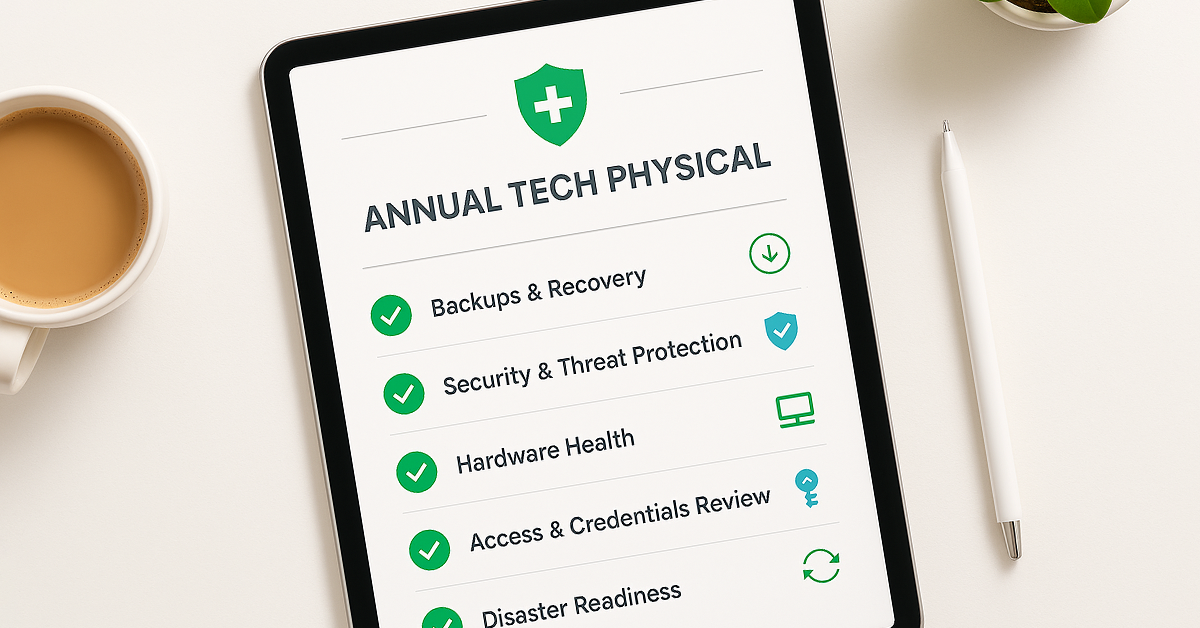
A professional technology assessment inspects your business tech with the precision and care of a medical exam—finding hidden risks before they explode into emergencies.
Critical Check: Backup and Recovery Reliability
This is the lifeline of your tech health. When disaster strikes, can you bounce back?
Ask yourself:
• Are backups completing fully, not just scheduled?
• When was the last time you successfully restored data from backup?
• If your server crashed at 9 a.m. Monday, how soon could you be operational? Do you have a verified answer?
Many discover failed backups only after a disaster—like realizing your airbags malfunction during a crash.
Core Strength: Hardware and Infrastructure Status
Technology hardware doesn't fail silently; it ages, performance declines, manufacturer support ends, and then inevitably breaks—often at the worst time.
- How old are your critical devices like servers, firewalls, and workstations?
- Are any past their manufacturer's support window — leaving you vulnerable to security risks?
- Do you replace equipment strategically, or only when it fails unexpectedly?
Aging hardware is a prime cause of downtime—working slower until it stops altogether.
Access Control: Reviewing User Permissions and Credentials
Do you really know who has access to what in your organization? If you're unsure, it's time for a review.
- Can you provide a complete list of users with system access?
- Are former employees or expired vendors still active in your systems?
- Are there shared accounts where activities cannot be traced back to an individual?
Unchecked access permissions often lead to security breaches—not due to negligence, but because regular housekeeping was overlooked.
Risk Assessment: Disaster Preparedness
It's uncomfortable to imagine worst-case scenarios, but preparing for them is critical.
- Do you have a tested, documented plan for a ransomware attack?
- Has your disaster recovery plan been rehearsed?
- How long could your operations survive without access to your IT systems?
If your plan is just "we'll figure it out," you're relying on hope, not preparedness.
Industry Compliance: Specialized Requirements and Standards
Each industry has its unique compliance 'health' criteria, enforced by external authorities.
- In healthcare, HIPAA compliance is mandatory — violations can result in fines up to $50,000 per incident.
- If you process credit cards, PCI compliance is non-negotiable to maintain payment processing.
- Security clauses in client contracts are increasingly strict and strictly enforced.
Generic advice won't cut it; you need expertise tailored to your industry's demands.
Signs It's Time for a Tech Checkup
If these sound familiar, don't delay:
"I think our backups are working." (Guessing is risky.)
"Our server is old but still functioning." (Like a car moments before a breakdown.)
"We might have ex-employees still listed in the system." (Why take chances?)
"Our disaster plan exists... somewhere." (Can you access it under pressure?)
"If [name] leaves, we'd struggle." (Avoid single points of failure.)
"We'd likely fail an audit, but no one's asked yet." (Don't wait for a surprise.)
The True Cost of Skipping Tech Maintenance
Regular checkups take hours, but failures can cost days, weeks, or even jeopardize your entire business.
Consider the stakes:
Data loss: Broken backups plus a server failure could erase all your client data, finances, and projects—disastrous and often irreversible.
Downtime: Each hour offline wastes money, productivity, sales, and damages client trust.
Compliance penalties: HIPAA fines can reach $50,000 per violation; losing PCI compliance means no credit card payments, and privacy laws keep getting tougher.
Ransomware attacks: Recovery now often costs small businesses over six figures, combining ransom, response, lost revenue, and reputation damage.
Prevention is affordable and straightforward.
Recovery? Expensive and embarrassing.
Why You Need a Professional Tech Checkup
You wouldn't assess your own health without a doctor's expertise—tech health is no different.
You require an expert who:
- Understands what healthy technology looks like for your business size and industry—not generic advice, but tailored standards.
- Has witnessed common failure patterns and knows which minor issues predict major outages.
- Sees your systems objectively, catching problems you might overlook because you're too close.
This is proactive fire prevention, not reactive firefighting.
Book Your Annual Tech Health Exam Today
Since you're already scheduling other preventive care this January, make sure to include a thorough technology checkup.
Schedule your Annual Tech Physical with us.
We will evaluate your IT environment and provide a clear, jargon-free health report outlining what's running smoothly, what's at risk, and what needs immediate attention before an emergency strikes.
No pressure. Just straightforward insight.
Click here or give us a call at 833-863-2120 to book your Consult.
The best moment to fix an issue is long before it becomes an emergency.
That moment is now.